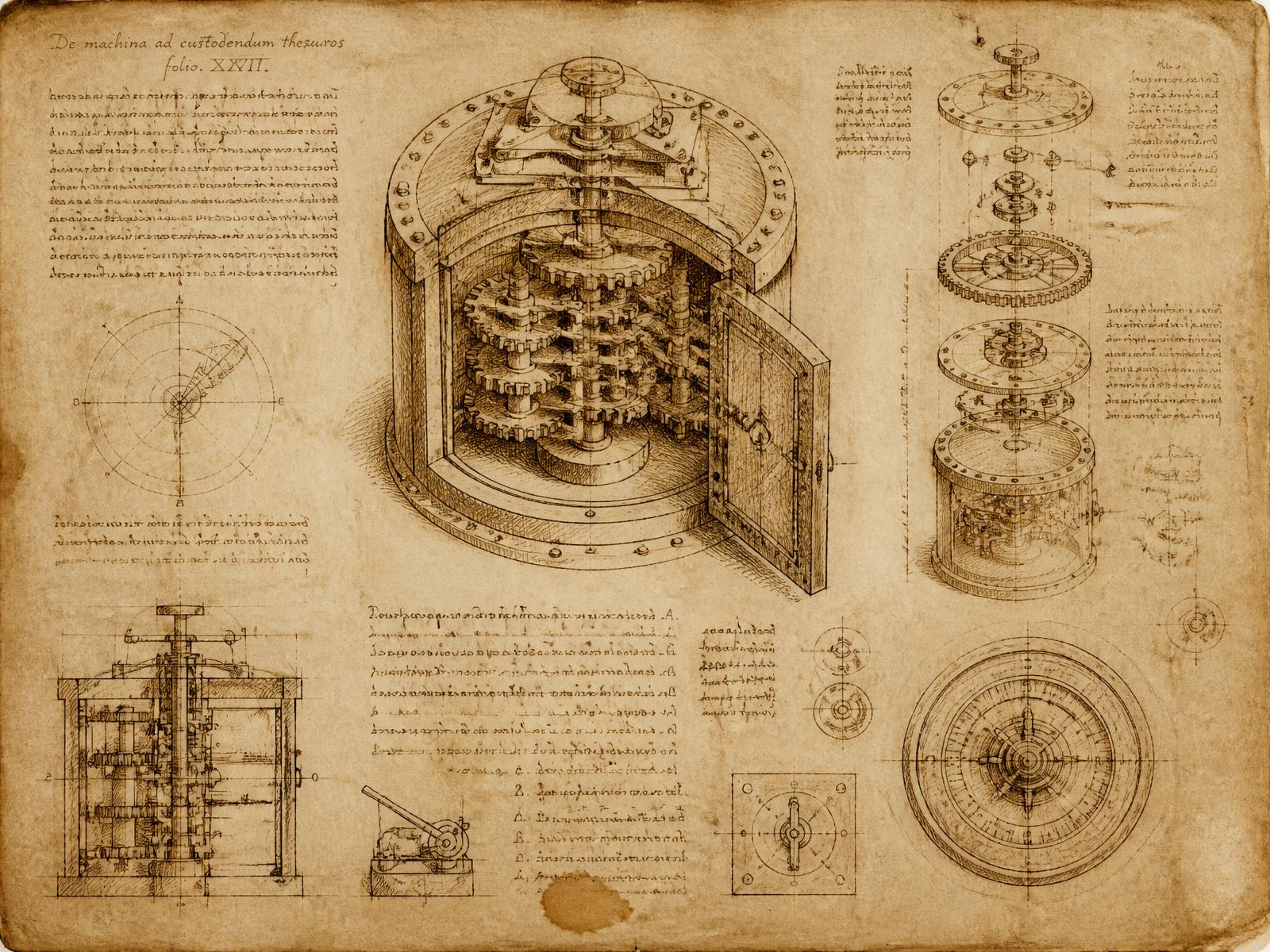
When did hidden compartments in furniture begin? Long before the padlock, long before the safe — the earliest secret compartments were carved into furniture as far back as the fifteenth century, when Renaissance patrons required a way to guard letters, coin, and confidences under their own roof.
I · Renaissance Cabinets — the beginning of trick furniture
The studiolo of a fifteenth-century Italian nobleman was, in effect, the first vault. Cabinet makers in Florence, Milan, and Augsburg competed to produce writing cabinets whose drawers, columns and plinths concealed further drawers behind them. A single visible cabinet might hold six or seven secret chambers, each released only by a specific sequence — press this rosette, slide that column, lift the false floor. This is the direct ancestor of modern secret compartment furniture.
II · The Age of Kunstschränke
By the late 1500s, Augsburg cabinetmakers were producing Kunstschränke — art cabinets — for the courts of Europe. They were engineering exhibitions as much as furniture: automata, mechanical clocks, and hidden compartments were combined in a single piece. The Pommersche Kunstschrank of 1617 is the most famous example. A visitor saw a cabinet; the owner saw a mechanism.
III · Roentgen's mechanical desks
The apogee of trick furniture arrived in the workshop of Abraham and David Roentgen in eighteenth-century Neuwied. Their desks — commissioned by Marie Antoinette and Catherine the Great — hid drawers behind drawers, sprung compartments behind sprung compartments, releases triggered by pressing a specific brass inlay. Some of their pieces required the correct twist of a candlestick, or the pulling of a specific volume on a false shelf. The Berlin Secretary Cabinet, completed around 1779, still baffles conservators.
IV · The Victorian gentleman's study
In the nineteenth century the secret compartment moved from the palace to the drawing room. Victorian gentlemen commissioned writing slopes, tea caddies, billiard tables and library shelves with hidden drawers for wills, letters, jewellery, and — with equal frequency — for less respectable pastimes. The English cabinet maker discovered that the best secret was a mundane one: a drawer that looked like a drawer, in a piece that looked like any other.
V · The mechanical century and its interruption
The early twentieth century refined the craft with precision steel, jewelled bearings, and combinations borrowed from watchmaking. Then, quietly, the tradition was interrupted. Electronic keypads, biometric readers, and battery-driven locking bars offered convenience — and, more importantly to manufacturers, they could be produced at scale. Handmade mechanical vaults, requiring months of filing and fitting, became commercially inconvenient. The craft did not die; it simply retreated into a handful of ateliers.
VI · Why the mechanism has outlasted the microchip
An electronic lock is a promise made in software. It relies on firmware that will be unsupported in a decade, a battery that will die in five years, a keypad that will inevitably be documented in a security advisory. A mechanical vault, by contrast, has no software surface to attack, no wireless protocol to intercept, no battery to exhaust. Its security is expressed in geometry and tolerance — properties that do not expire.
The old cabinet makers understood this instinctively: they were not building for the decade, but for the century. A well-engineered mechanism outlasts every fashion in encryption because the mechanism does not depend on fashion.
VII · The modern atelier
At Secret Vaults, we work in that inherited lineage. Our book vaults descend from the Renaissance studiolo; our hidden furniture is the great-grandchild of the Roentgen desks; our multi-stage mechanisms are engineered with the same patience as the Kunstschränke of Augsburg. We keep no electronics in the mechanism itself — the only intelligence required is that of the owner.
The history of secret compartment furniture is not a museum piece. It is a working tradition — quieter than it once was, but unbroken.